
en

A slab scissor lift will run on gravel if the surface has been graded and compacted to the point where a loaded wheel does not sink. On most construction sites that condition is not met, and the machine that should go out is a rough-terrain unit instead. The decision is not about whether the ground looks hard. It is about contact pressure at the tyre, and that number is easy to work out before the machine leaves the yard.
Deciding whether a scissor lift on gravel is viable does not start with walking on it, or driving a pickup across it. Neither says anything about a 2,550 kg machine standing on four solid rubber tyres with a contact patch 127 mm wide. A person spreads about 80 kPa. The same patch of ground carrying one corner of a GTJZ-1012 takes something close to half a megapascal.
The gap between those two numbers is the whole problem. Gravel that carries a van comfortably will still let a scissor lift cut four ruts, and once the ruts are there the machine is on a slope whether the site knows it or not.
Take the GTJZ-1012. Machine weight 2,550 kg, four wheels, tyre 381 x 127 mm. Static load per wheel is about 637 kg, or 6.25 kN. With roughly 100 mm of tyre flat on the ground, the contact area is around 0.0127 m², which gives about 490 kPa. Round it to 500 kPa and treat that as the floor.
Then add the real working condition. A platform loaded to 320 kg with two people on one side and the extension deck out does not share load evenly. The worst-loaded wheel sees about half again as much, so design for 700 to 750 kPa at one corner.
| Condition | Load per wheel | Contact pressure |
|---|---|---|
| GTJZ-1012, empty, level | 6.3 kN | ~490 kPa |
| GTJZ-1012, 320 kg, deck out, one side loaded | ~9.4 kN | ~740 kPa |
| GTJZ-0810, 450 kg, deck out, one side loaded | ~8.3 kN | ~650 kPa |
| GTJZ-0810-Z, 320 kg, deck out | ~7.5 kN | ~590 kPa |
A graded and compacted granular sub-base at 95% compaction will usually hold 500 kPa without visible deformation. Most site haul roads are not at 95%. That is why the same machine works all week on one site and digs itself in on the next one, and nobody can explain the difference.
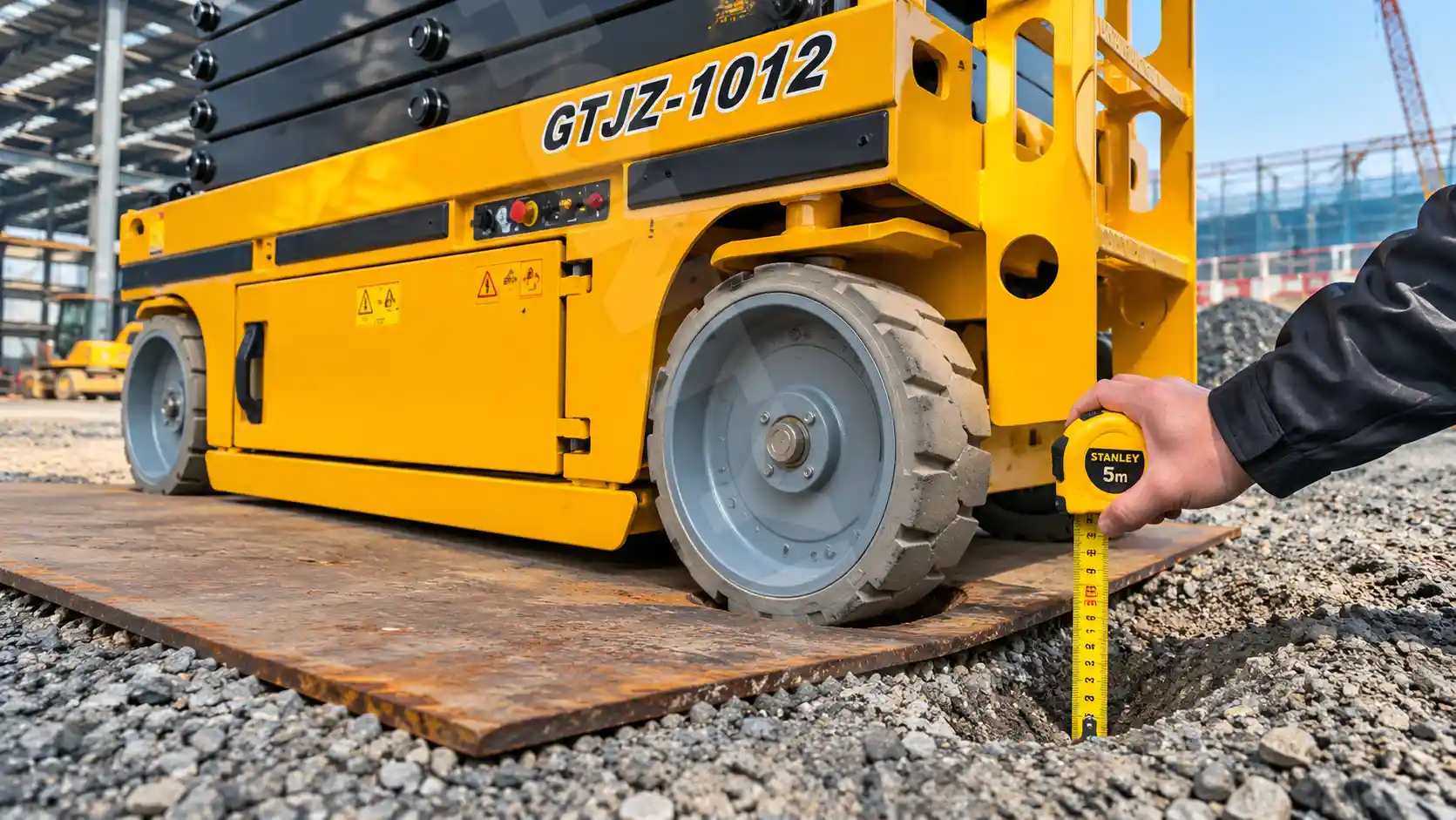
Steel plate under each wheel is the cheapest way to make a graded site usable. Plate thickness matters more than plate size.
Rut depth. Walk the route and look for existing ruts from delivery vehicles. Anything over 30 mm means the surface has already failed under lighter loads than yours, and the machine will follow those ruts. Do not drive across them at an angle.
Water test. Pour a bottle of water on the surface. If it disappears in under a minute the material is loose and draining too freely, which usually means it is not bound. If it sits on top and does not drain at all, the sub-base is saturated and its strength is a fraction of the dry figure. Both results mean the surface is not ready.
Slope. A 10% grade looks almost flat on a site and is already at the limit for comfortable operation on loose material. Our slab models are rated to 25% gradeability on a firm surface, but that figure assumes the tyres are gripping, not ploughing.
Four things turn a marginal site into a usable one for a scissor lift on gravel, and none of them is about the machine.
Plate the wheel paths. Not the whole route, just where the wheels go. Twelve millimetre steel plate is enough for a 2,550 kg machine if the ground under it is flat. Timber is not, at this weight, and neither is plywood.
Choose the lighter machine. If the job is 8 m of working height, the GTJZ-0810 at 2,250 kg puts roughly 100 kPa less into the ground than a 10 m unit. That difference decides whether you need plate at all on a marginal site. Going narrower does not help here: the 840 mm GTJZ-0810-Z at 2,050 kg concentrates the same load into a smaller footprint, so its contact pressure is higher than its weight suggests.
Keep the route dry. A site that was fine on Monday is a different site after two days of rain. The sub-base does not drain as fast as the surface suggests, and the failure happens at the first loaded wheel, not the last.
Backfill placed within the last three months. It has not finished settling, whatever the plate test says.
Rain within the previous 24 hours on a granular surface.
Existing ruts deeper than 30 mm, or any soft patch you can push a boot heel into.
Grade above 10%, or any cross-slope on loose material.
Within a distance of 1.5 times the excavation depth from any open trench edge, regardless of surface.
In any of those cases the answer is a rough-terrain scissor lift, and we will say so rather than ship a slab machine and let the site find out. If you need the job done on that ground and only have a slab unit, the honest option is to wait, or to build a proper running surface.
Every machine leaves with a tread depth reading on the pre-delivery sheet. Below 40% remaining we change the tyre before shipment, because a worn solid tyre puts the same load through a smaller patch and lifts contact pressure by roughly a fifth. On a hard warehouse floor that is a comfort issue. On gravel it is the difference between crossing the site and sinking into it.
If you send us the ground conditions and the route, we will tell you whether a scissor lift on gravel is viable at your site before you order. Send the site details, or see the full range on the self-propelled scissor lifts page.
Tell us the constraint you are stuck on — floor loading, doorway width, cold store, aisle width, charge window. We will tell you which model works, what it costs, and what we would refuse to sell you.
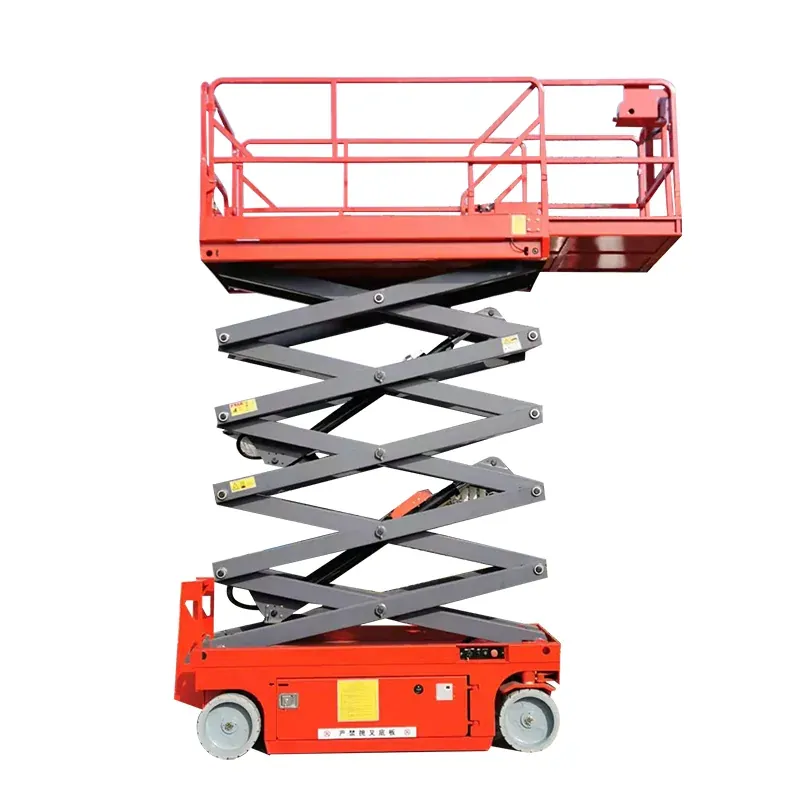 GTJZ-0810 26ft (7.8 m) Self-Propelled Scissor Lift — 450 kg
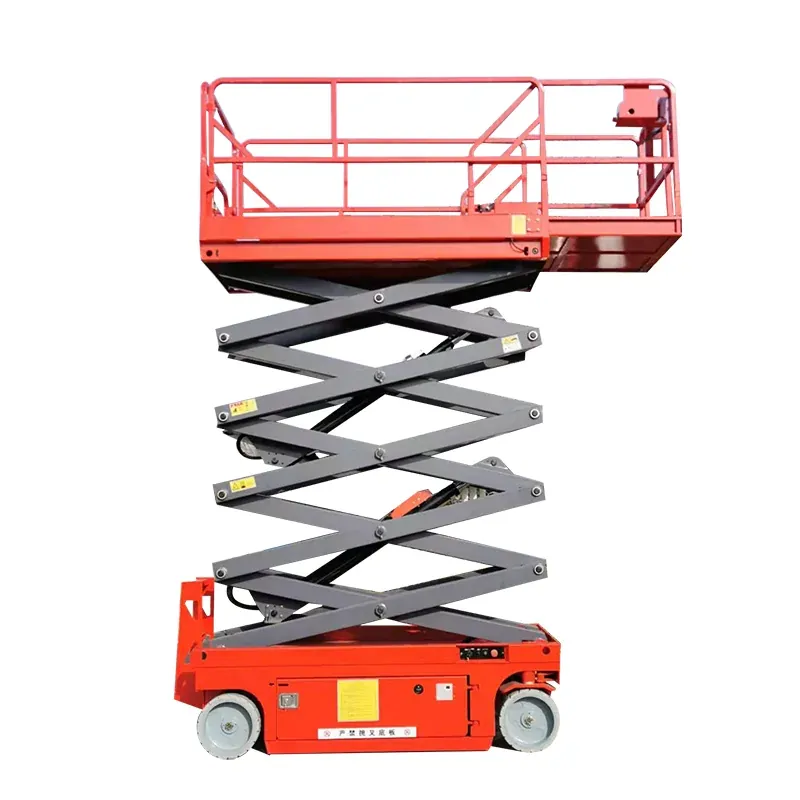 GTJZ-0810-Z Narrow 840 mm Scissor Lift — 26ft (7.8 m), 320 kg
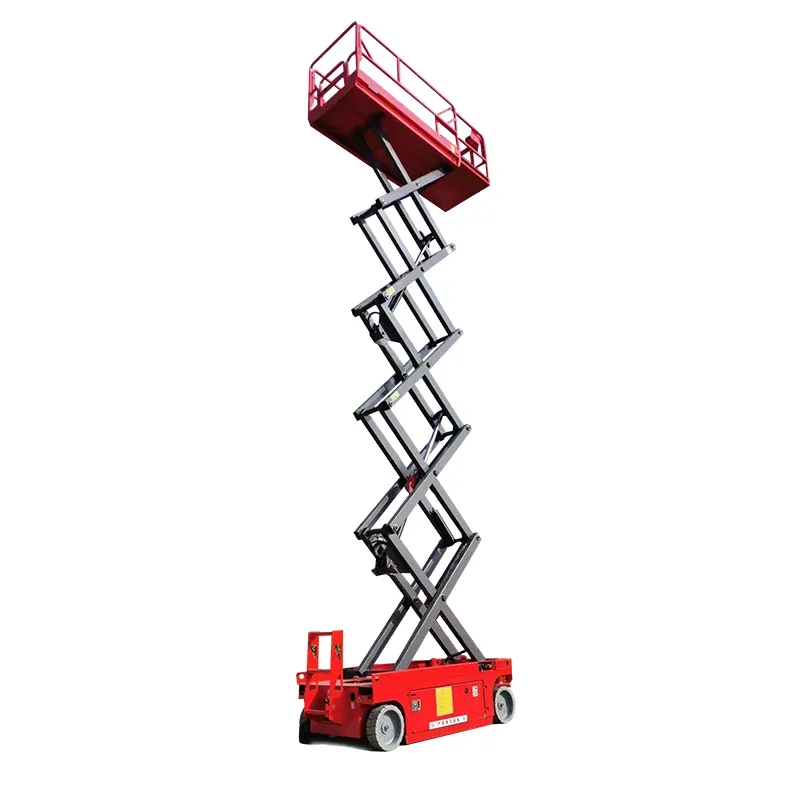 GTJZ-1012 32ft (9.8 m) Self-Propelled Scissor Lift — 320 kg