
en

Yes, for curtain wall sealant access over the lower eight to twelve metres of a flat facade, and only if three conditions hold: the ground in front of the building can take 500 kPa without marking, the work face is within reach of the platform without extending over a projection, and the building can accept a machine standing on its forecourt for the duration. When any of those three fails, scaffolding is the right answer and a scissor lift is not.
Most of the discussion about a scissor lift for curtain wall work focuses on height. Height is the easy part to answer: a 9.8 m platform with a person standing on it puts the working hands at roughly 11.5 m, which covers the first three floors of a typical commercial building. The GTJZ-1416 at 13.8 m covers four to five.
The constraint that actually stops projects is the ground. A 2,550 kg machine on four solid tyres standing on a paved forecourt applies about 500 kPa per wheel, and more when the platform is loaded and the deck is out. Polished granite paving laid on a sand bed will not take that without visible damage. Neither will asphalt in a heatwave. We have seen a facade job stopped on day two because the client's own paving contractor refused to sign off on the marks.
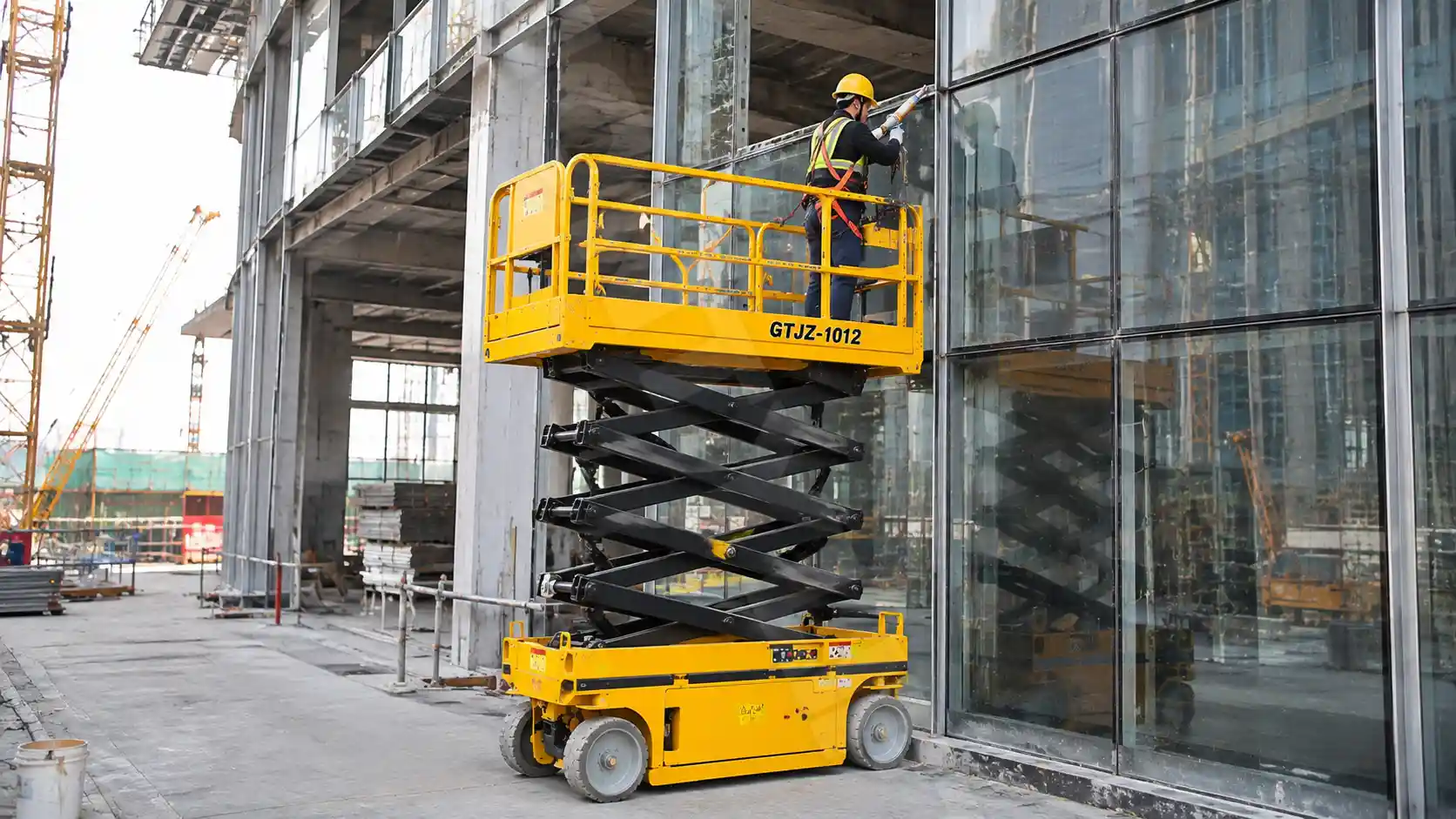
The platform sits parallel to the glass for the whole pass. That is the reason sealant work suits a scissor rather than a boom.
Scaffolding is not expensive because of the hire charge. It is expensive because of the footprint. A five-storey independent scaffold with a 1.2 m working lift and debris netting occupies a strip about 2.4 m wide along the elevation, plus a 0.6 m safety zone. On a 30 m elevation that is 90 m² of forecourt closed for the duration, and the duration is two weeks for erection, work and striking.
| Item | Scaffolding, 30 m elevation, 3 floors | Scissor lift, same elevation |
|---|---|---|
| Ground occupied | ~90 m² closed for 2 weeks | ~6 m² of working position, moved as work progresses |
| Set-up time | 2-3 days erection, 1 day strike | None; machine arrives on a trailer |
| Access to retail entrance | Usually blocked or reduced | Maintained, if the route is planned |
| Work rate, sealant | Continuous face, but fixed once built | Limited by repositioning, not by the platform |
| Ground protection needed | Base plates on spreaders | Plate under each wheel, or a load-spreading mat |
Choosing a scaffolding alternative is not about which is faster. It is about whether the building can afford to lose its frontage for two weeks. On a trading retail unit, that single point usually decides the method on its own.
Plan the passes, not the days. A scissor lift for curtain wall re-sealing works one vertical strip at a time. Mark the elevation in 2.27 m widths, which is the platform length on the 1012, and treat each strip as a separate task. A two-person crew sealing joints does roughly one strip per hour on a clean facade, so a 30 m elevation is 13 passes, or about two working days including moving and set-up.
Keep the platform close. Scissor lift facade work needs the operator within about 300 mm of the joint. The machine has to sit parallel, which means the ground in front of the facade has to be clear of planters, bollards and steps for the whole length. Walk the elevation with a tape before you commit.
Use the deck, not the guardrail. The extension deck extends the usable floor by 900 mm on the 1012, which is what lets the operator reach past a mullion without leaning over the rail. Leaning over the rail is the thing that turns a routine job into an incident, and it happens on every facade job where the deck was left retracted to save time.
For scissor lift building maintenance we ask three questions: what is the highest joint to be sealed, what is the ground surface in front of the elevation, and can the forecourt be closed to vehicles for the duration. With those answers we can say whether a GTJZ-1012 or the taller GTJZ-1416 is the right unit, or whether we should tell you to keep the scaffold.
On facade enquiries we ask for a photograph of the ground, not of the building. The building tells us the height, which we can read from the drawing. The ground tells us whether the job is possible, and it is the one thing customers rarely send. Send both through the contact form and the answer is usually back the same day.
Tell us the constraint you are stuck on — floor loading, doorway width, cold store, aisle width, charge window. We will tell you which model works, what it costs, and what we would refuse to sell you.
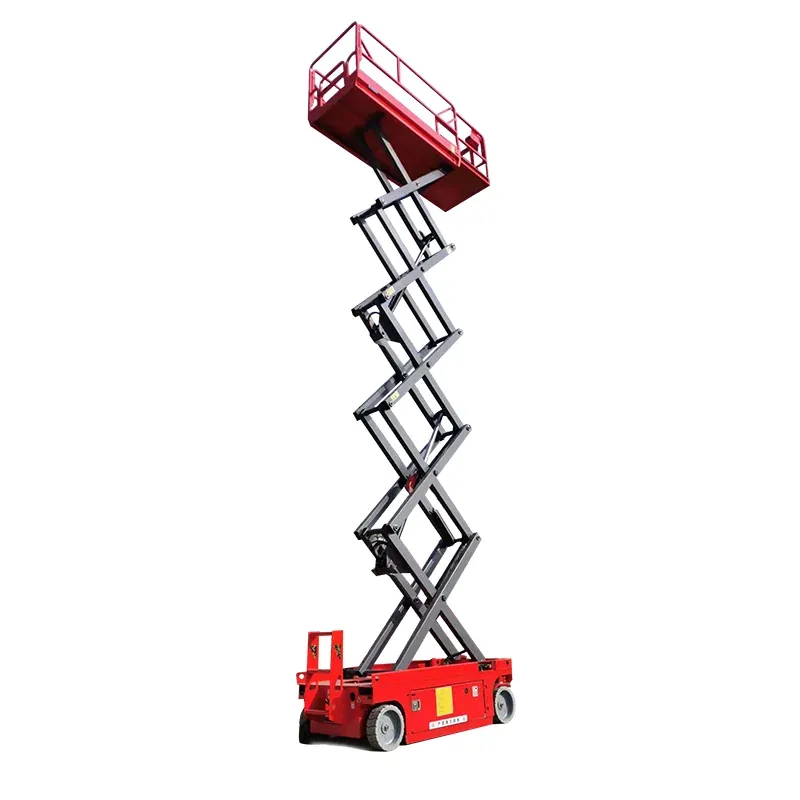 GTJZ-1416 45ft (13.8 m) Scissor Lift, No Outriggers — 230 kg
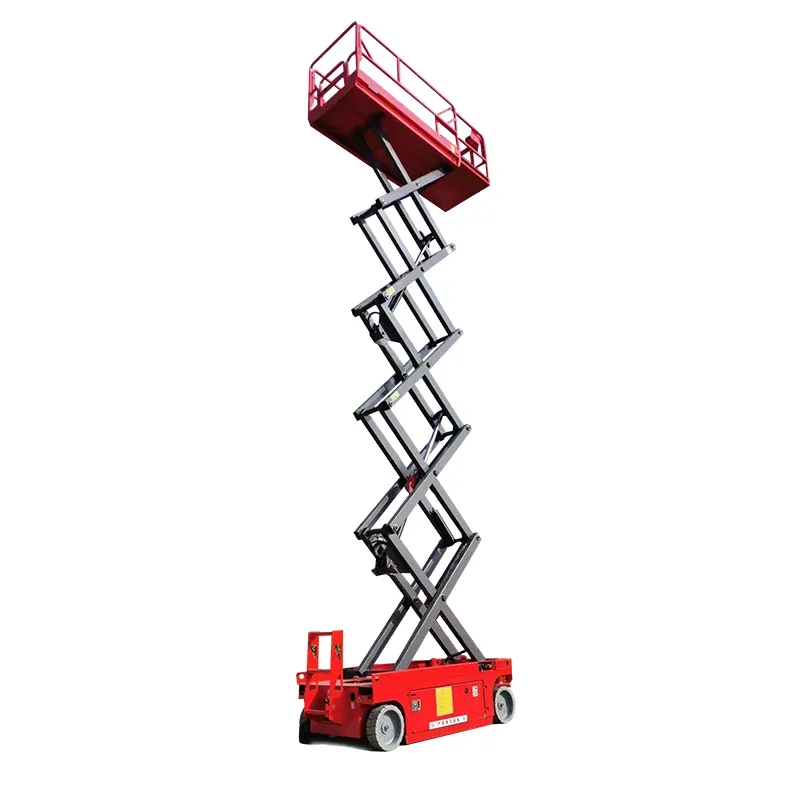 GTJZ-1012 32ft (9.8 m) Self-Propelled Scissor Lift — 320 kg