
en

Scissor lift high temperature operation does not fail the machine as a whole. Above 45°C ambient, four specific things fail, in a predictable order: hydraulic oil temperature, battery charging, tyres, and controller thermal derating. All four are manageable, and none of them require a different machine. They require a different operating pattern between May and September, and the pattern has to be decided before the season rather than during it.
The hydraulic system is specified around a normal ambient band. At 45°C ambient, with the machine working through a lift cycle every few minutes, oil temperature in the tank climbs past 80°C and stays there. Seals that would last five years at 60°C last a fraction of that at 85°C, because elastomer life roughly halves for every additional 10°C above its rated band.
The symptom is not a failure. It is a machine that starts weeping at the cylinder gland in its second summer, and a customer who concludes the machine was badly built. The fix is operational: cap continuous lifting at about four hours, then let the machine stand for an hour with the platform down — and on a scissor lift, that hour on a 45-degree day is not optional. If the site cannot accept that, the honest answer is two machines on rotation, which is cheaper than three seal rebuilds a year.
A lead-acid pack charged at 45°C ambient is being charged at a temperature where its acceptance voltage has dropped and its internal resistance has risen. Charging it at the cool-weather rate drives it into thermal runaway, and thermal runaway in a sealed pack means a bulged case and a written-off battery.
| Charging condition | Effect on pack life | What to do |
|---|---|---|
| Charged at 25-30°C | Baseline | Nothing |
| Charged at 40°C | Roughly half the cycles | Shade the machine, charge on the cooler side of the building |
| Charged at 45°C or above | Thermal runaway risk | Do not charge. Move to a cooled area or wait until night |
| Charged immediately after a shift in sun | Worst case | Let the machine stand 60 minutes before plugging in |
The charging area is the single most important piece of infrastructure on a hot-climate site, and it is usually an afterthought. A shade net over the charging bay costs very little, and the battery charging heat it removes does more for pack life than any specification upgrade available on the machine.
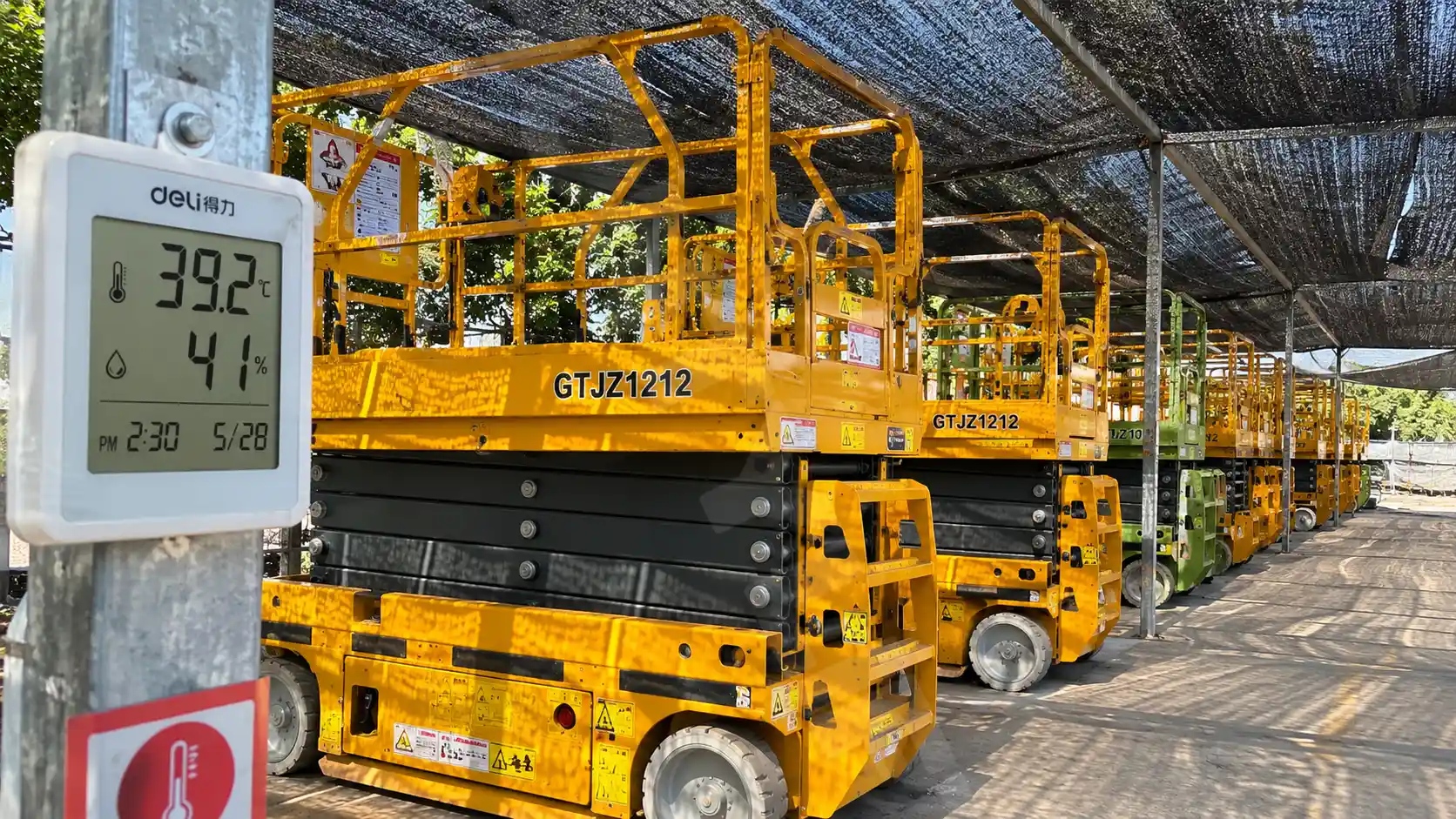
Shade over the charging area does more for battery life than any specification change on the machine.
Solid rubber tyres soften as surface temperature rises. A tyre that grips at 30°C at 0.8 km/h raised travel speed will slide at 60°C surface temperature, and the surface in a yard in direct sun is far hotter than the air. The visible consequence is flat-spotting from braking, and the invisible one is a machine that will not hold position on a ramp it managed in April.
Two operational responses: keep the machines off dark asphalt in direct sun when they are not working, and reduce travel speed when raised to the minimum the job allows. A flat-spotted tyre cannot be repaired, only replaced.
The controller protects itself by reducing output when its heatsink exceeds a set temperature. On a machine in direct sun at 45°C ambient, with the box in its usual position, this happens in the middle of the afternoon and presents as "the machine has gone slow". Nothing is broken. The operator reports a fault, the hire company sends a fitter, and the fitter finds nothing on the diagnostic.
If a site reports afternoon slowdowns and no fault codes, check box temperature before anything else. Shade, or a reflective cover over the box, resolves it.
For Gulf destinations we ask for the charging arrangements before we confirm the order, not because the machine changes but because the conversation is easier before the container ships than after the first battery claim. Customers who have shade and a night-charging routine get the same pack life as a European fleet. Customers who charge in the sun at midday replace packs every eighteen months, and then conclude that scissor lift high temperature operation does not work in their climate at all.
The narrow-body GTJZ-0810-Z is often the better hot-climate choice for indoor work because it can be parked inside the building rather than in the yard, which solves the storage temperature question entirely. The full range is on the range page, and site conditions can be discussed through the contact form.
Tell us the constraint you are stuck on — floor loading, doorway width, cold store, aisle width, charge window. We will tell you which model works, what it costs, and what we would refuse to sell you.
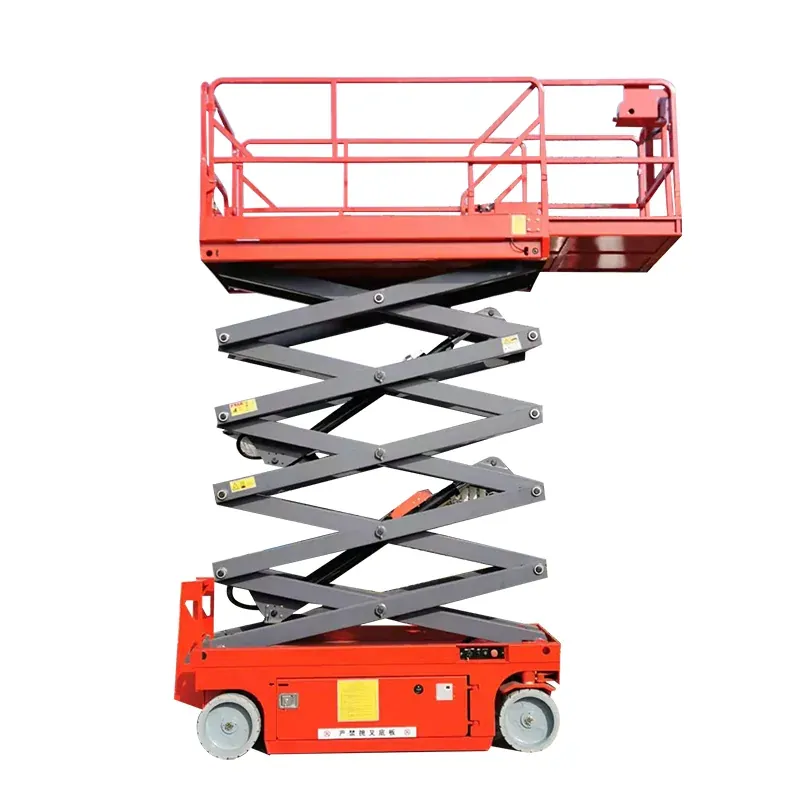 GTJZ-0810 26ft (7.8 m) Self-Propelled Scissor Lift — 450 kg
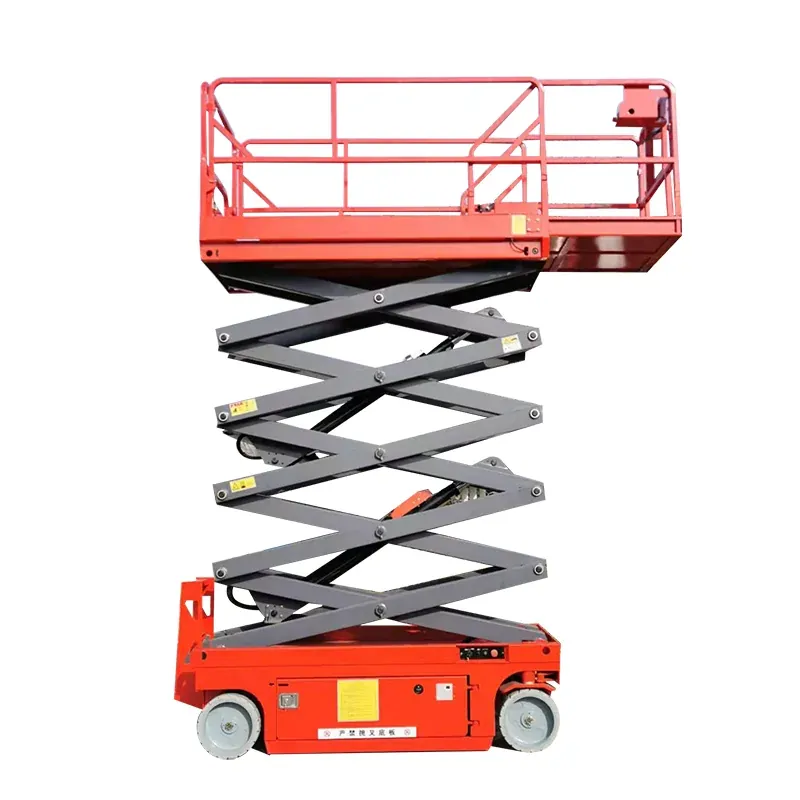 GTJZ-0810-Z Narrow 840 mm Scissor Lift — 26ft (7.8 m), 320 kg
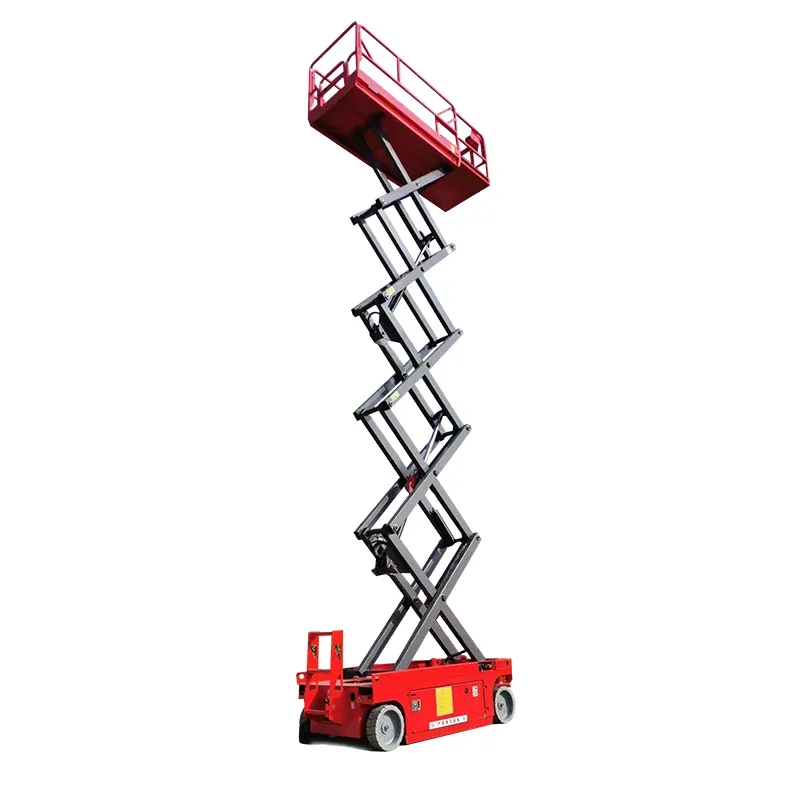 GTJZ-1012 32ft (9.8 m) Self-Propelled Scissor Lift — 320 kg