
en

Using a scissor lift for AS/RS aisle work is possible, but only during a system stop, and only if the machine never touches the stacker crane rail. The rail is installed to a tolerance measured in single millimetres, and a machine standing on or near it can move it far enough to put the crane into a positioning fault that takes days to diagnose. Aisle width is the question everybody asks. Rail protection is the question that decides whether the job is possible.
In a stacker crane aisle, positioning comes from a laser distance meter reading against a reflector, and the crane travels on a floor rail. The rail installation tolerance on a typical system is around ±3 mm over its length in both height and alignment. The crane's absolute positioning depends on that rail being where the commissioning engineer left it.
Now put 2,050 kg on four solid tyres inside that aisle. The floor loading is not the issue; a modern AS/RS floor is designed for the racking and the crane. The issue is contact. A wheel crossing the rail applies a point load at the rail's edge, and a rail fixed with anchors into a power-floated slab will move a little. A little is enough. The crane then reads a position error, stops, and the maintenance team spends two days looking at the laser before anyone thinks to check the floor.
| Risk | Mechanism | Control |
|---|---|---|
| Rail displacement | Wheel point load on rail edge | Plate bridging over the rail, or a marked crossing point with a fixed ramp |
| Crane collision | Machine parked in the crane's travel path | Aisle physically isolated during the stop, key control on the crane isolator |
| Sensor obstruction | Machine or person blocking a photo-eye | Machine stays outside the sensor line when not working |
| Dust on rail | Tyres carrying debris onto the running surface | Clean the route before entry; clean the rail after |
AS/RS aisles are narrow by design, typically 1,200 to 1,800 mm between rack uprights, because every millimetre of aisle is lost storage. A standard 1,160 mm machine leaves almost nothing once you allow for the operator's feet and the platform overhang.
This is where the 840 mm GTJZ-0810-Z earns its place as a scissor lift narrow aisle machine. At 840 mm wide it fits a 1,200 mm aisle with 180 mm either side, which is enough to work but not enough to be careless. Its platform is 2,270 x 810 mm, so the operator stands in a corridor rather than a room, and the extension deck matters more than usual because the only way to reach past a rack face is forward.
Below 1,200 mm clear, no scissor lift for AS/RS aisle access belongs in the aisle at all. The work has to be done by the crane itself, by a climbing team, or by removing racking.
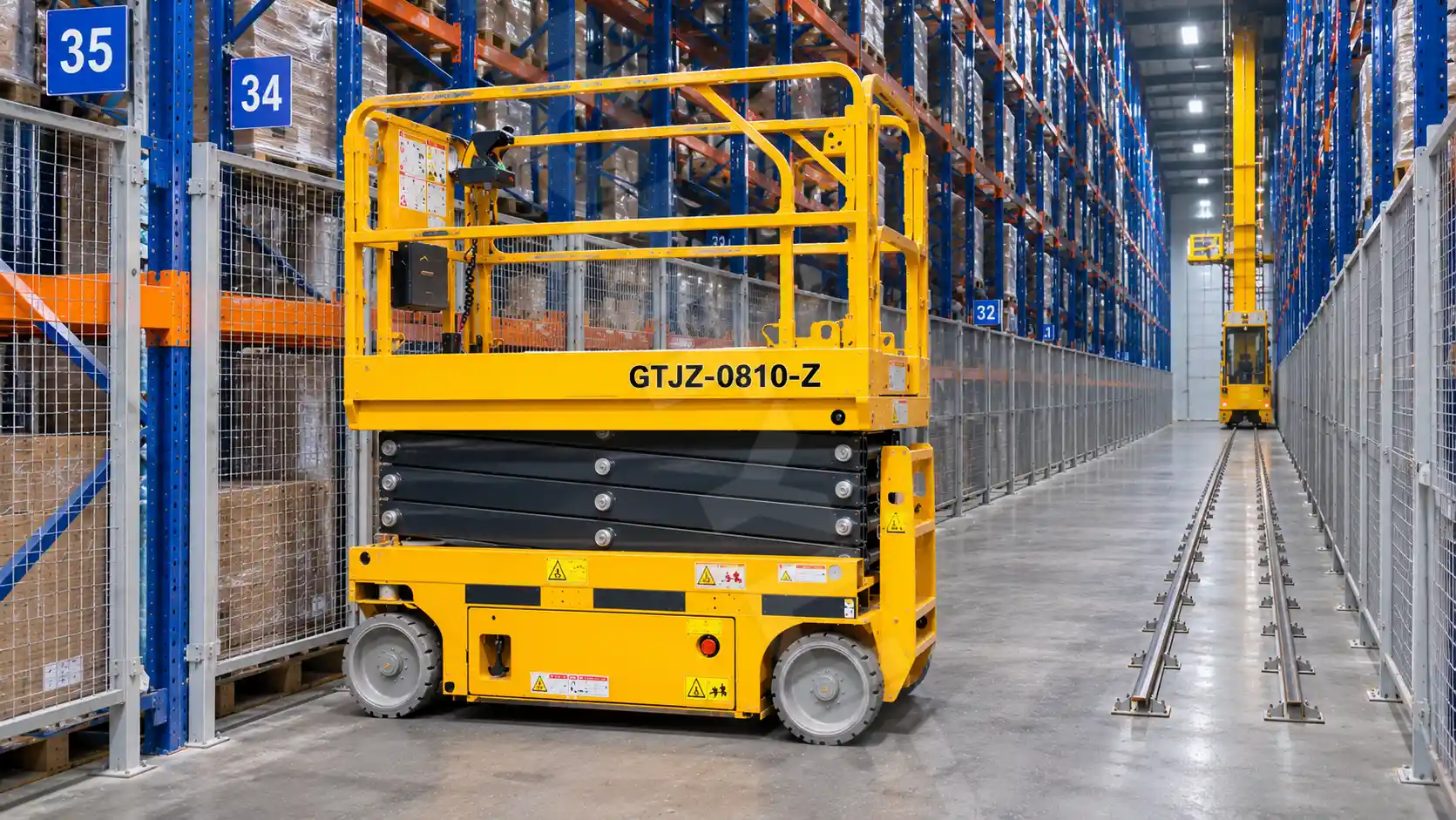
The rail is the constraint, not the racking. A lift that touches it takes the whole storage system offline.
AS/RS maintenance access happens in planned windows, and the window is usually shorter than the work. Three things determine whether the machine helps or hinders:
Entry route. The machine has to get into the aisle from outside the system, which usually means a transfer aisle at the end, a door with a height limit, and a turning area. Measure the route, including the door threshold, before booking the machine. A 1,940 mm folded height is fine for most transfer aisles and not for all doors.
Working height against rack height. The 7.8 m platform on the 0810-Z reaches 9.8 m working height, which covers racking up to about nine levels of typical pallet beam pitch. Taller systems need the 9.8 m or 11.8 m machines, and those are wider, which puts the aisle width question back on the table.
Who else is in the aisle. If the stop is for a crane service, the crane engineer is also in the aisle, and two people working in a 1,200 mm corridor with a machine between them is not a plan. Sequence the work: machine first, crane second, or the reverse.
When a customer asks about automated warehouse access, we ask for two dimensions before anything else: aisle width at the narrowest point, including any protruding beam connector, and the height of the door into the transfer aisle. We do not ask for the rack height first, because the rack height only decides which model, while those two dimensions decide whether any model can enter at all. Roughly half the enquiries we get for automated warehouses turn out to need a machine we do not make, and it is cheaper to say so at that point than after a container has arrived.
Send the aisle drawing through the contact form and we will mark the usable band on it. Machine dimensions for the narrow units are on the GTJZ-0810-Z and GTJZ-0608-M pages.
Tell us the constraint you are stuck on — floor loading, doorway width, cold store, aisle width, charge window. We will tell you which model works, what it costs, and what we would refuse to sell you.
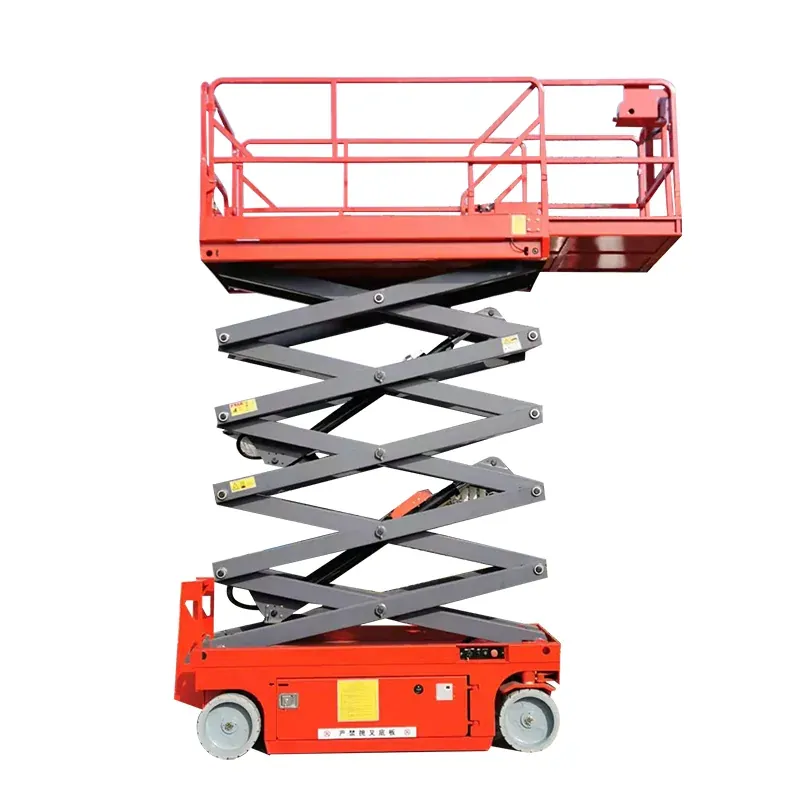 GTJZ-0810 26ft (7.8 m) Self-Propelled Scissor Lift — 450 kg
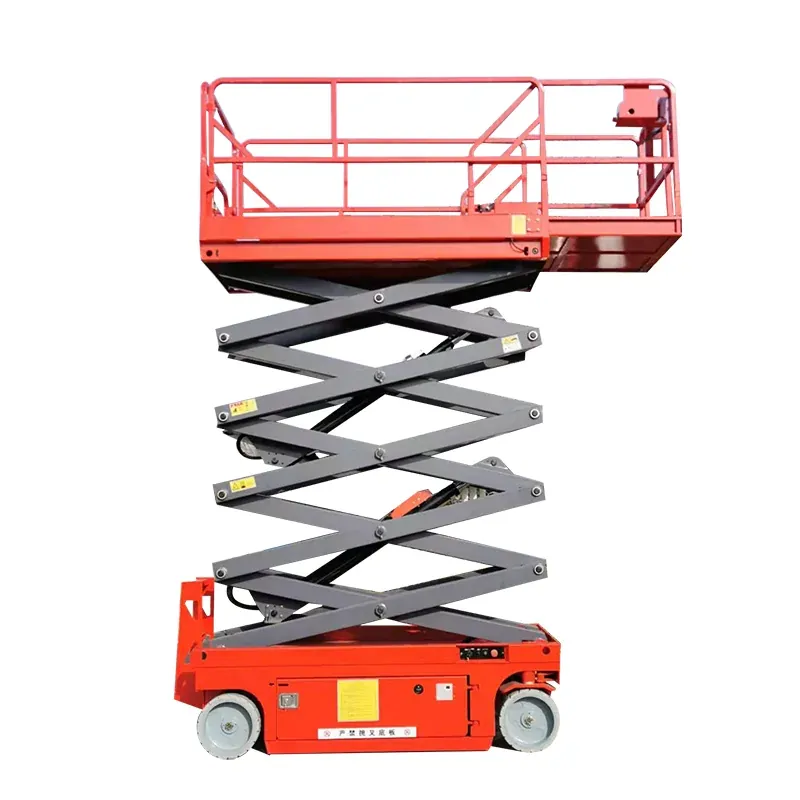 GTJZ-0810-Z Narrow 840 mm Scissor Lift — 26ft (7.8 m), 320 kg
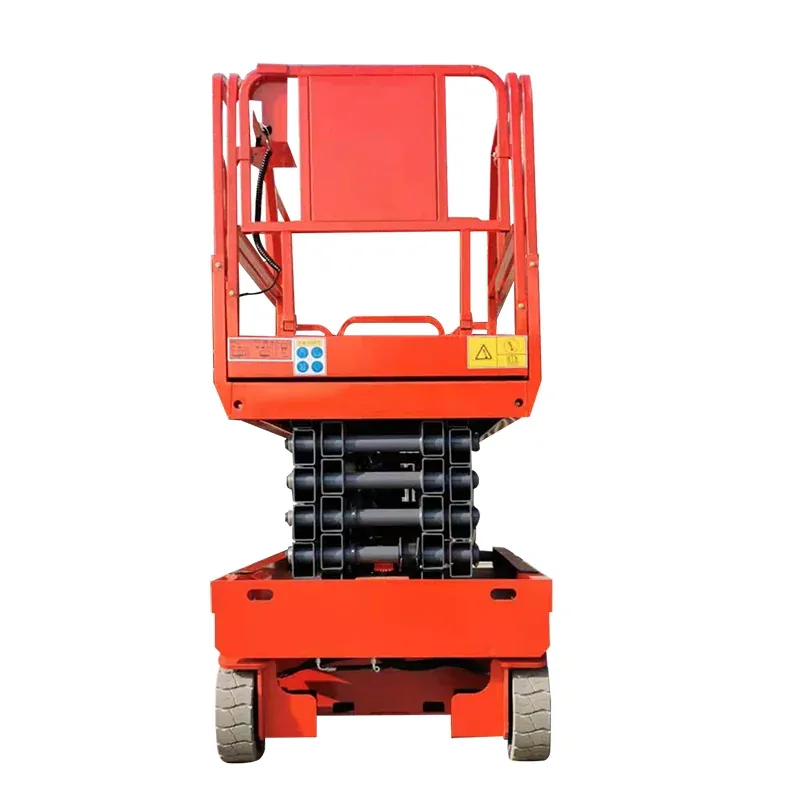 GTJZ-0608-M Compact 19ft (5.8 m) Hydraulic Drive Scissor Lift — 230 kg