
en

Bent guardrails account for more scissor lift damage charges than any other single item, and in most disputes the customer pays. Not because the damage is theirs. They pay because the hire company cannot prove the machine left in the condition it claims. The evidence that decides these cases is created in the first ten minutes of the hire, not in the argument at the end, and it consists of four photographs and one signed line. Companies that take those four photographs win most of these conversations without ever having an argument.
Damage disputes are not settled at the hire return inspection. They are settled by establishing a timeline, and the timeline has four points.
| Point | What exists | What it proves |
|---|---|---|
| Dispatch | Four corner photographs, hour meter, signed dispatch note | Condition at the start |
| Handover on site | Customer signature accepting the machine | Customer had the chance to reject it |
| Return | Same four photographs, same angles | Condition at the end |
| Assessment | Written description and repair quote | Cost, and whether it is wear or damage |
Break any one of those four and the case weakens. Break the second — the handover signature — and it usually collapses, because the customer can then say the damage was present on arrival and there is nothing to contradict them.
Local impact. A dent in one place, with cracked or flaked paint at the dent, and the rail line either side of it still straight. This is contact with something — a racking upright, a door frame, another machine. It is chargeable guardrail damage, and the repair is usually a rail section replacement.
Bowing along the length. The rail curves outward over 600 mm or more, paint intact, no single impact point. This is almost always a load: something heavy leaned against or tied to the rail, or a person standing on the mid-rail. It is chargeable and it is worth a conversation, because the same behaviour causes falls and the customer needs to know why it is not acceptable.
Wear without deformation. Scratches, paint loss at the corners, a slightly loose gate latch. This is normal use and should not be charged. Charging for it is the fastest way to lose a repeat customer, and it is the most common complaint we hear about hire companies.
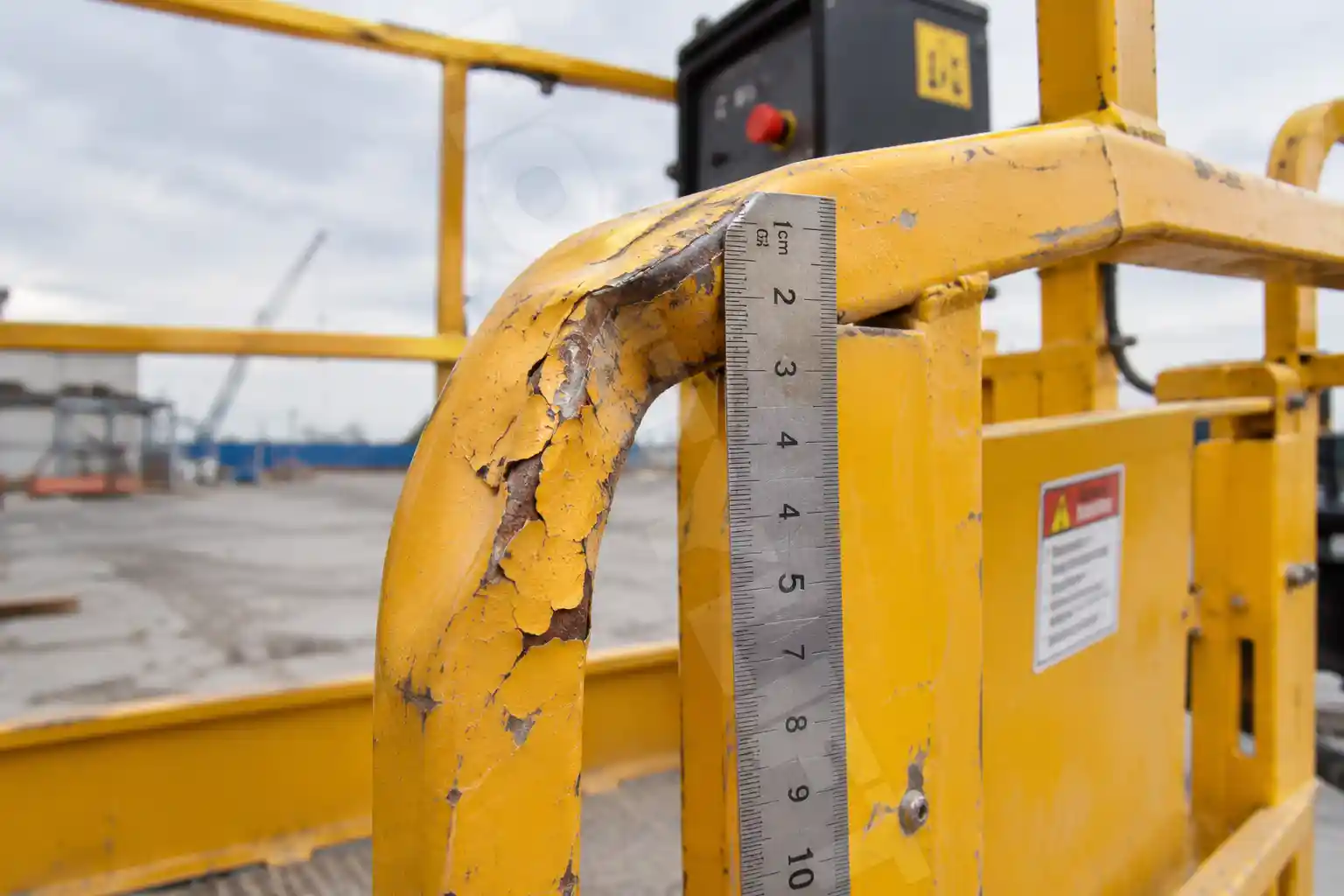
A dent with cracked paint is a collision. A rail that bows outward along its length is usually a load. The two are charged differently.
Put a straight edge along the top rail and measure the gap. Under 5 mm over the length of a section is within what the rail will take without affecting its function, and it is not worth charging. Over 5 mm at any single point, or any deformation that stops the gate closing squarely, and the rail has to be replaced.
The gate matters more than the visual. A gate that has to be lifted to close, or that latches only when pushed hard, is a fall risk regardless of how the rail looks. That is the point to make to a customer: it is not about the dent, it is about the latch.
Publish the rates before the hire. A customer who knows at booking that a rail section is a fixed charge and a pothole bar is a fixed charge does not argue about whether the scissor lift damage charges are fair; they argue about whether it happened, which is a much easier conversation and one the photographs usually settle.
Offer a damage waiver as an alternative to a dispute. For a small percentage of the hire, the customer accepts the first band of damage and the hire company absorbs the rest. It removes the argument entirely, and in our experience fleets that offer it spend less time on claims than fleets that do not, even though the headline revenue is lower.
We mark four photograph positions with tape on the wash bay floor and include the positions in the PDI sheet. It sounds trivial. It is the single change that most improves a hire company's recovery rate, because it turns four photographs into a comparable set rather than four pictures of a machine. Fleets that adopt it stop losing the arguments they should win.
The narrow-body machines are the ones that come back with rail damage most often, simply because an 840 mm chassis encourages operators to squeeze through gaps that the rail does not fit through. If that is your pattern, the GTJZ-0810-Z page lists the actual dimensions to check against your access routes. The rest of the range is on the range page.
Tell us the constraint you are stuck on — floor loading, doorway width, cold store, aisle width, charge window. We will tell you which model works, what it costs, and what we would refuse to sell you.
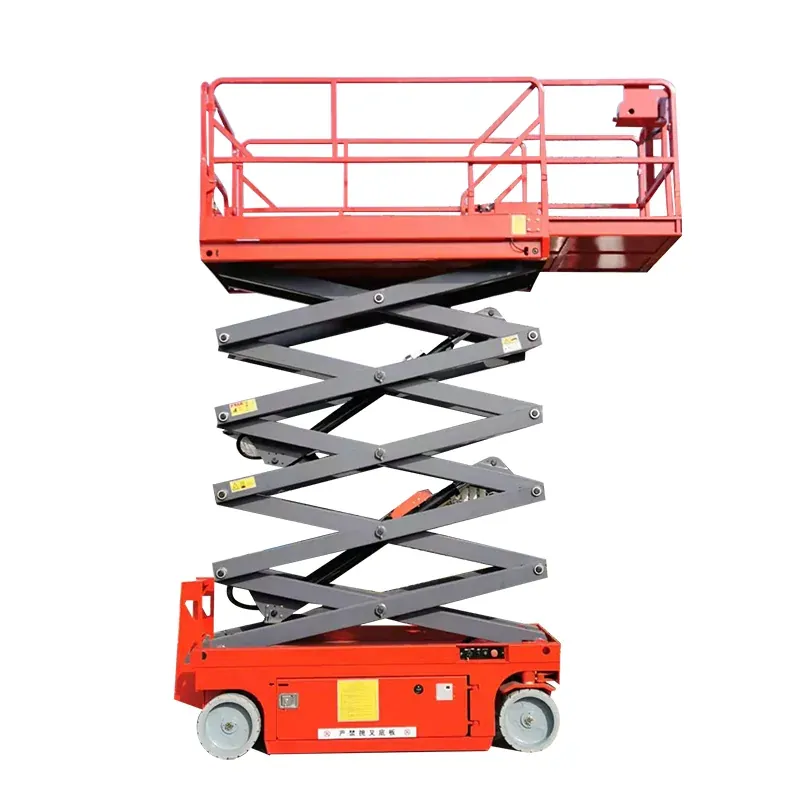 GTJZ-0810 26ft (7.8 m) Self-Propelled Scissor Lift — 450 kg
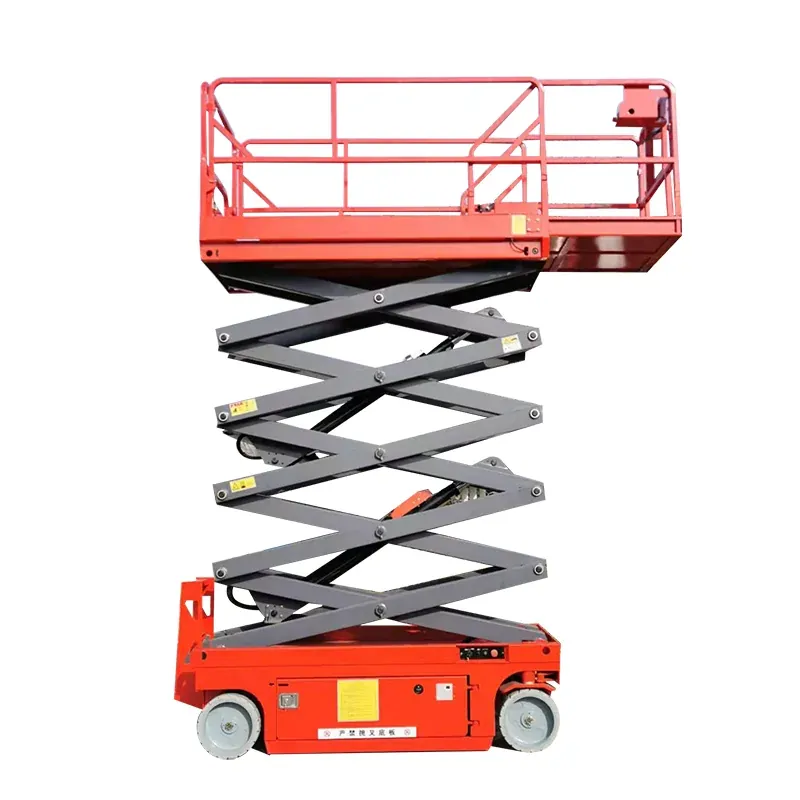 GTJZ-0810-Z Narrow 840 mm Scissor Lift — 26ft (7.8 m), 320 kg