
en

Scissor lift warehouse traffic management is usually written as a courtesy rule, and that is why it fails. In a shared aisle, the scissor lift gives way, always, and it should not be in the aisle while a forklift is moving through it. The reason is not courtesy. It is that a forklift carrying a load has roughly three metres of floor it cannot see, and a scissor lift is a stationary, quiet object that the driver has no reason to expect. Below 1,800 mm of clear aisle width, the two should not be in the same space at all, however careful the drivers are.
A counterbalance forklift with a load on the forks has its forward view blocked from about waist height down, and that is the scissor lift blind spot that matters. The driver sees over the load only if the load is low. At typical racking loads of 1.2 to 1.8 m, the visible floor in front of the machine starts around three metres ahead of the forks, and closer than that the driver is working from memory and mirrors.
A scissor lift working at the rack face is 1,160 mm wide, 2,390 mm long, and standing still with the platform up. It is below the driver's sight line, it makes almost no noise, and it does not move. Every one of those characteristics works against being noticed.
| Condition | Risk | Control |
|---|---|---|
| Forklift with load, driver view blocked | ~3 m of unseen floor ahead | No lift in the aisle while forklifts are running; physical barrier or cone line |
| Lift working at rack face | Below driver sight line, silent | Aisle closed to vehicles, not shared |
| Aisle under 1,800 mm | No passing clearance | One machine type in the aisle at a time |
| Forklift braking distance at 8 km/h | 3 to 5 m on a dry floor | Speed limit and floor marking before the work zone |
Shared aisles usually run on an informal understanding: the forklift drivers know the lift is there, and they slow down. That works until a relief driver covers a shift, or a new contract brings in agency staff, or the lift moves to a different aisle and nobody updates the briefing. The failure is not the regular drivers. It is the tenth driver who does not know.
A control that depends on everyone remembering is not a control, and scissor lift warehouse traffic management that rests on it will fail. The practical version is a physical one: a cone line or a barrier at each end of the aisle being worked, and a rule that the aisle is closed to vehicles while the platform is up. It costs a few minutes per task and removes the entire category of incident.
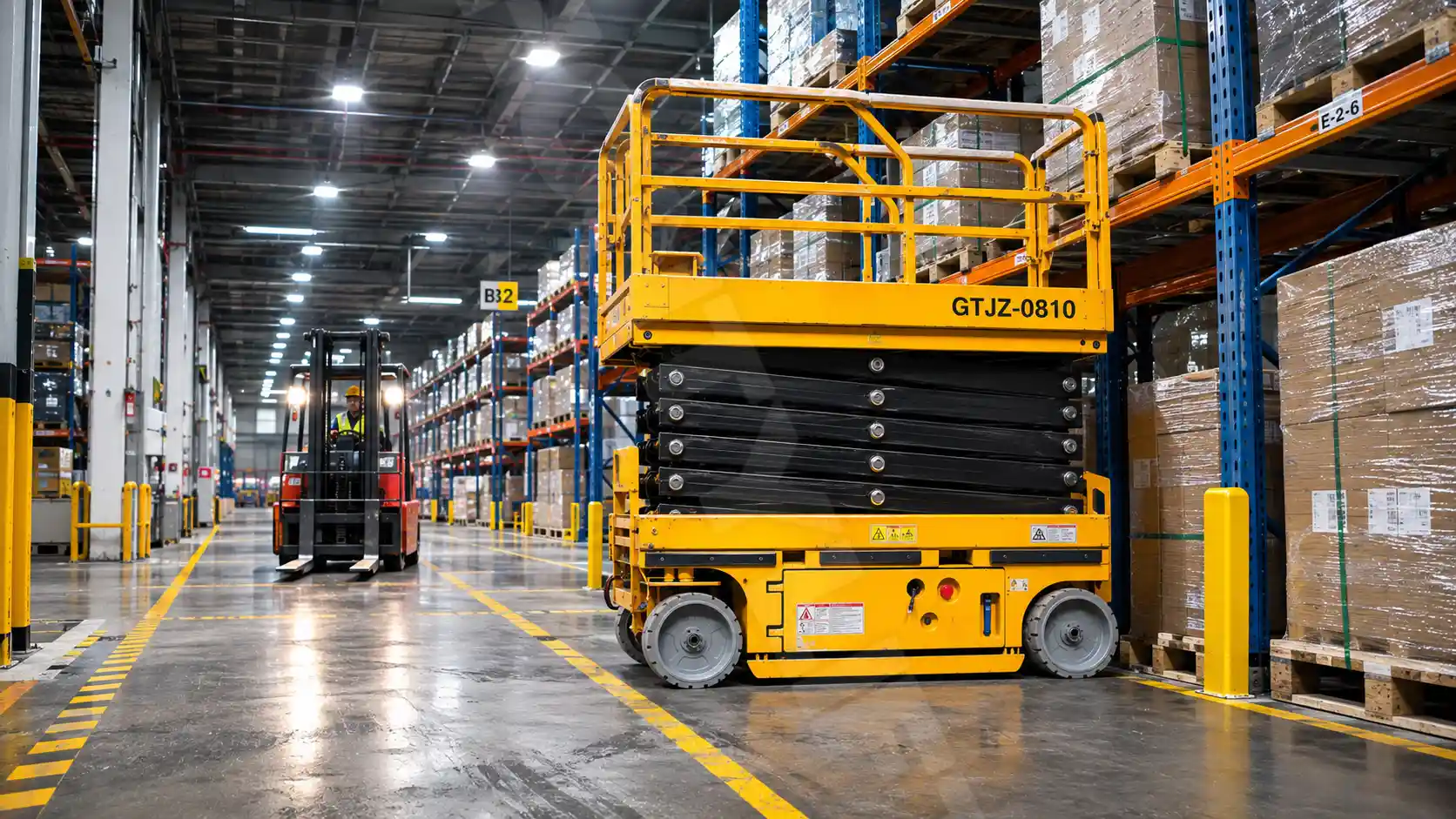
The lift is stationary and quiet. The forklift driver has three metres of blind floor in front of the forks and no reason to expect a machine there.
In a forklift and scissor lift aisle, the 1,160 mm machine needs about 1,600 mm to travel with any margin, and more to turn. A counterbalance forklift needs 3.5 to 4 m to turn in an aisle and about 2.5 m to pass a stationary object safely.
Add those together and the arithmetic is uncomfortable: the aisle width a scissor lift needs to share with a forklift is about 4 m clear. Most warehouse aisles between racking are 3.2 to 3.6 m, which is enough for a forklift and not enough for a forklift and a scissor lift at the same time. That is why the rule is sequence, not sharing.
The exception is the 840 mm GTJZ-0810-Z, which can work in an aisle that a standard machine cannot enter. It does not make the aisle shared. It makes the work possible in aisles where the alternative was no access at all, and the vehicle exclusion rule still applies.
We ship a set of four magnetic warning signs with every warehouse order: two for the aisle ends and two for the machine. It is a trivial item and it is the one customers mention most often a year later, because the signs are what turns an informal understanding into something a new driver can see. The machines themselves have nothing to do with this problem, and no specification change will fix it.
If you are planning maintenance work in a live warehouse, send the aisle widths and the forklift type through the contact form and we will tell you whether the work can be sequenced inside operating hours. Machine widths are on the GTJZ-0810-Z and GTJZ-0608-M pages.
Tell us the constraint you are stuck on — floor loading, doorway width, cold store, aisle width, charge window. We will tell you which model works, what it costs, and what we would refuse to sell you.
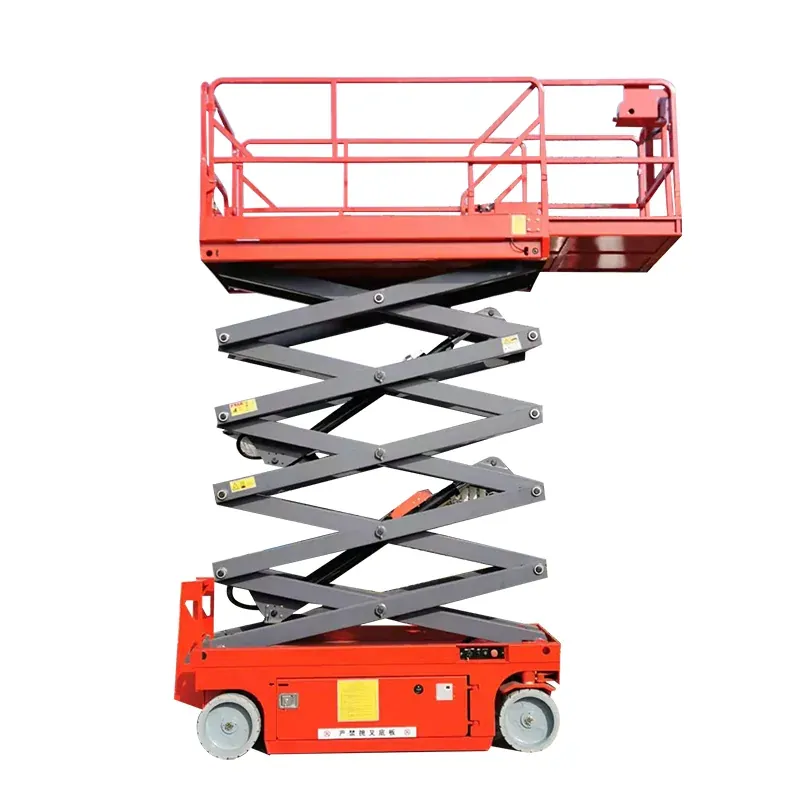 GTJZ-0810 26ft (7.8 m) Self-Propelled Scissor Lift — 450 kg
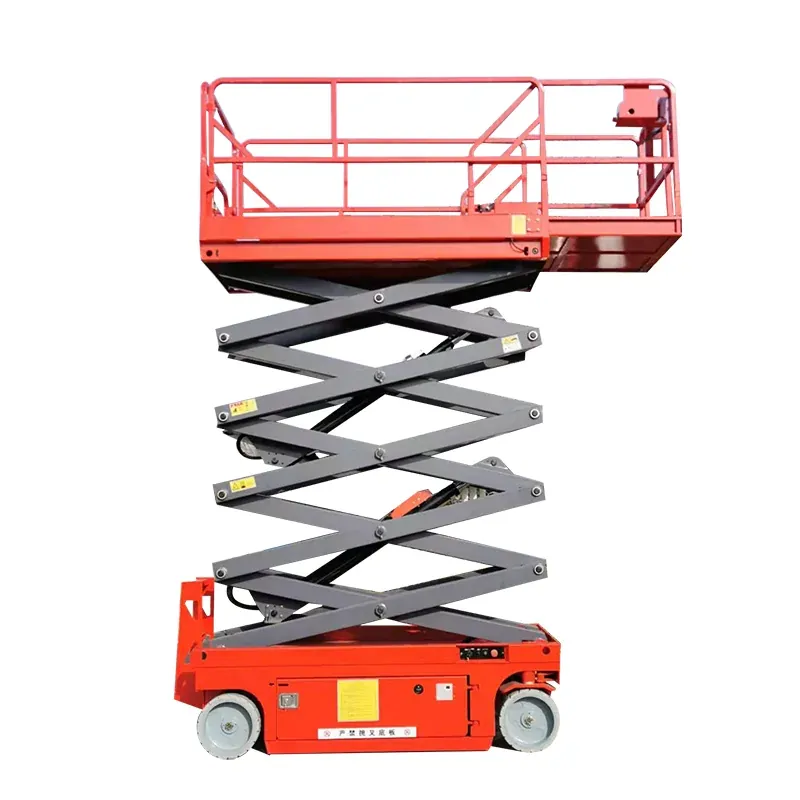 GTJZ-0810-Z Narrow 840 mm Scissor Lift — 26ft (7.8 m), 320 kg
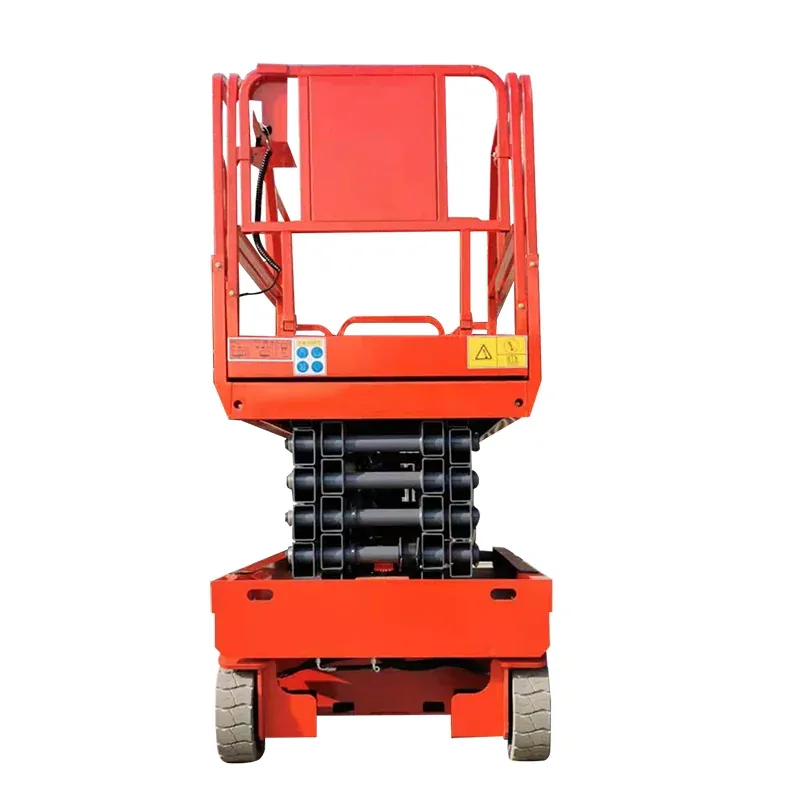 GTJZ-0608-M Compact 19ft (5.8 m) Hydraulic Drive Scissor Lift — 230 kg