
en

The black line across the mall floor is usually not the tyre compound. Buyers specify non-marking tyres expecting the marks to stop, and then send us photographs of a scuff that a non-marking wheel cannot physically have made.
Non-marking means one specific thing: the compound contains no carbon black, so it transfers no pigment. It does not mean the tyre leaves no trace. Understanding which mark you are looking at decides whether you need a different compound, a different driving technique, or a call to the hydraulic technician.
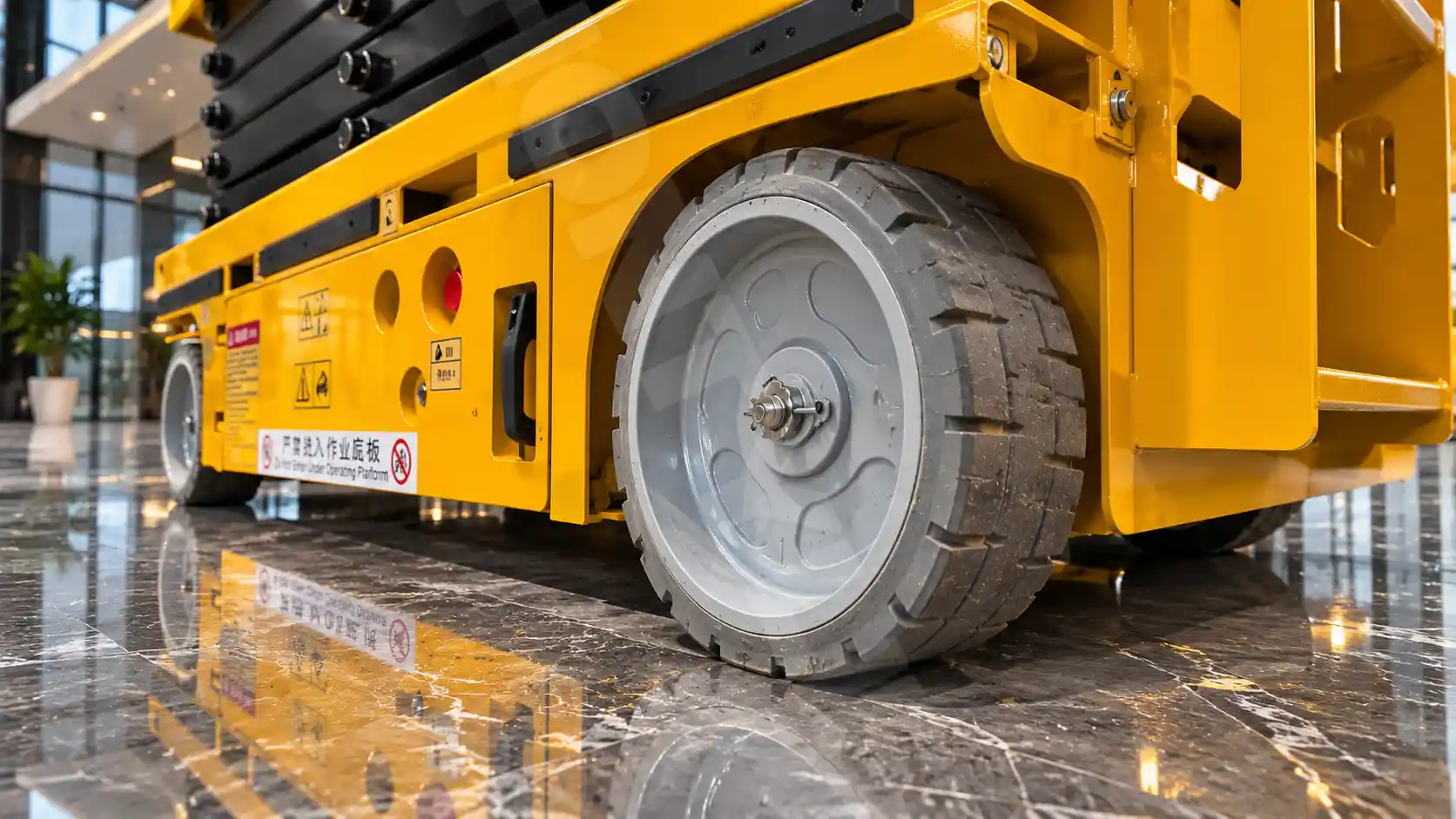
A non-marking tyre resting on a polished stone floor.
Standard industrial tyres are black because carbon black is the reinforcing filler, and it is cheap and effective. A non-marking tyre replaces it with a light-coloured filler, usually silica-based, which gives a grey or off-white tyre that leaves no black pigment on the floor.
What it does not change is friction. A rubber wheel turning on polished stone under load generates shear at the contact patch, and shear leaves a mark whatever the colour of the rubber. That mark is a smear of the floor's own surface, or a transfer of the compound itself, and it is grey rather than black. It is also the mark that gets photographed and sent to the supplier.
Hydraulic weep. A slow leak at a cylinder rod seal or a hose fitting leaves a thin film that collects dust and turns into a dark smear along the machine's path. It looks exactly like a tyre mark and it never appears where the wheels are. Wipe the floor under the chassis after a shift: if the film is oily rather than powdery, it is hydraulic, and the machine needs a seal.
Brake and metal contact. A dragging brake or a worn wheel bearing produces a fine metallic line, usually curved, always in the same place on the route. It comes with a noise the operator has learned to ignore.
Lateral shear on polished stone. Turning on full lock on a polished surface, particularly with a load on the platform, drags the tyre sideways. On a non-marking tyre this leaves a faint grey arc that fades over days but is very visible on the day. It is a driving issue, not a compound issue, and the fix is a wider turn or a different route through the building.
| Compound | Where it works | Where it fails |
|---|---|---|
| Non-marking rubber | Polished stone, epoxy, sealed concrete, retail floors. Good grip, quiet, forgiving on joints | Wears faster than black rubber. Load capacity per wheel is lower, so it is not the right choice on the 1,400 mm and 1,420 mm models |
| Polyurethane | High load, smooth concrete, long runs. Low rolling resistance, long life | Harsh on joints and thresholds, less grip when wet, and it can mark a hot floor in direct sun through glazing. Noisy on tile |
| Pneumatic or air-filled | Outdoor yards, rough ground, kerbs | Black, marks everything, and the wrong answer indoors in every respect |
The practical guidance we give: an indoor scissor lift under 1,200 mm wide takes non-marking rubber. Above 1,400 mm and mostly outdoor, pneumatic. Polyurethane only when the floor is smooth concrete and the loads are heavy, and never on polished stone.
Polished marble or granite. The hardest surface to keep clean, because any shear shows. Non-marking rubber, slow turns, and a mat at every transition where grit is carried in. Grit under a wheel is what actually scratches stone, and no compound prevents it.
Epoxy and sealed concrete. Forgiving. The mark to watch is the hydraulic film, which stains epoxy permanently if it is left.
Vinyl and PVC tile. The problem is not marking but indentation. A 2,550 kg scissor lift on four wheels will leave a compression mark in a soft vinyl floor if it stands in one place for a shift. Move it, or spread the load with a plate under each wheel.
Carpet tiles. Fibre crush, not marking, and the crushed patch does not recover. Route the electric scissor lift along the same line and accept the line, or protect the carpet.
Three of them, and they cost less than a set of tyres:
Name the floor surface and the building type in the enquiry, not just "non-marking". A scissor lift specified for a warehouse and delivered to a shopping centre will mark the floor, and the argument about whose fault that is has never once been won by the supplier who shipped the wrong compound.
We fit non-marking rubber as standard on the compact scissor lifts and quote it as an option on the rest, and we will tell you when the floor you describe does not suit the compound you asked for. Tell us the floor and we will tell you the wheel.
Send the working height, the load and the site constraint. An engineer replies with a model recommendation and a written quotation within one business day — or tells you it cannot be done.
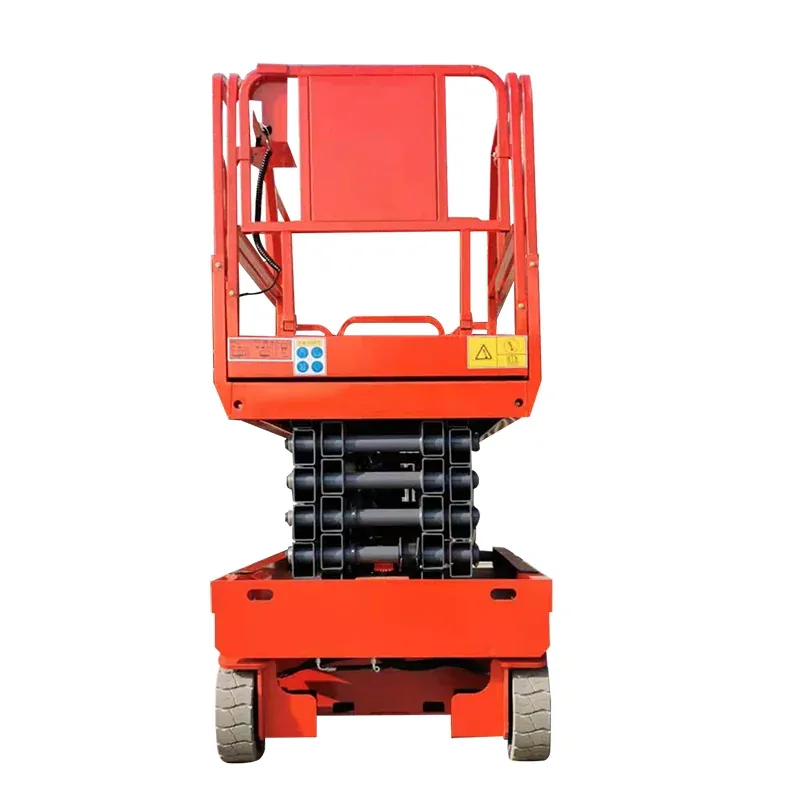 GTJZ-0608-M Compact 19ft (5.8 m) Hydraulic Drive Scissor Lift — 230 kg