
en

Most of the calls we get about a lift that will not drive are not faults. The scissor lift is doing exactly what it was built to do, and the operator is standing on it wondering why it has stopped.
Three interlocks can stop an electric scissor lift, and they trigger in a predictable order. Knowing that order turns a two-hour service visit into a three-minute walkaround, and it also tells you when the machine really does need a technician.
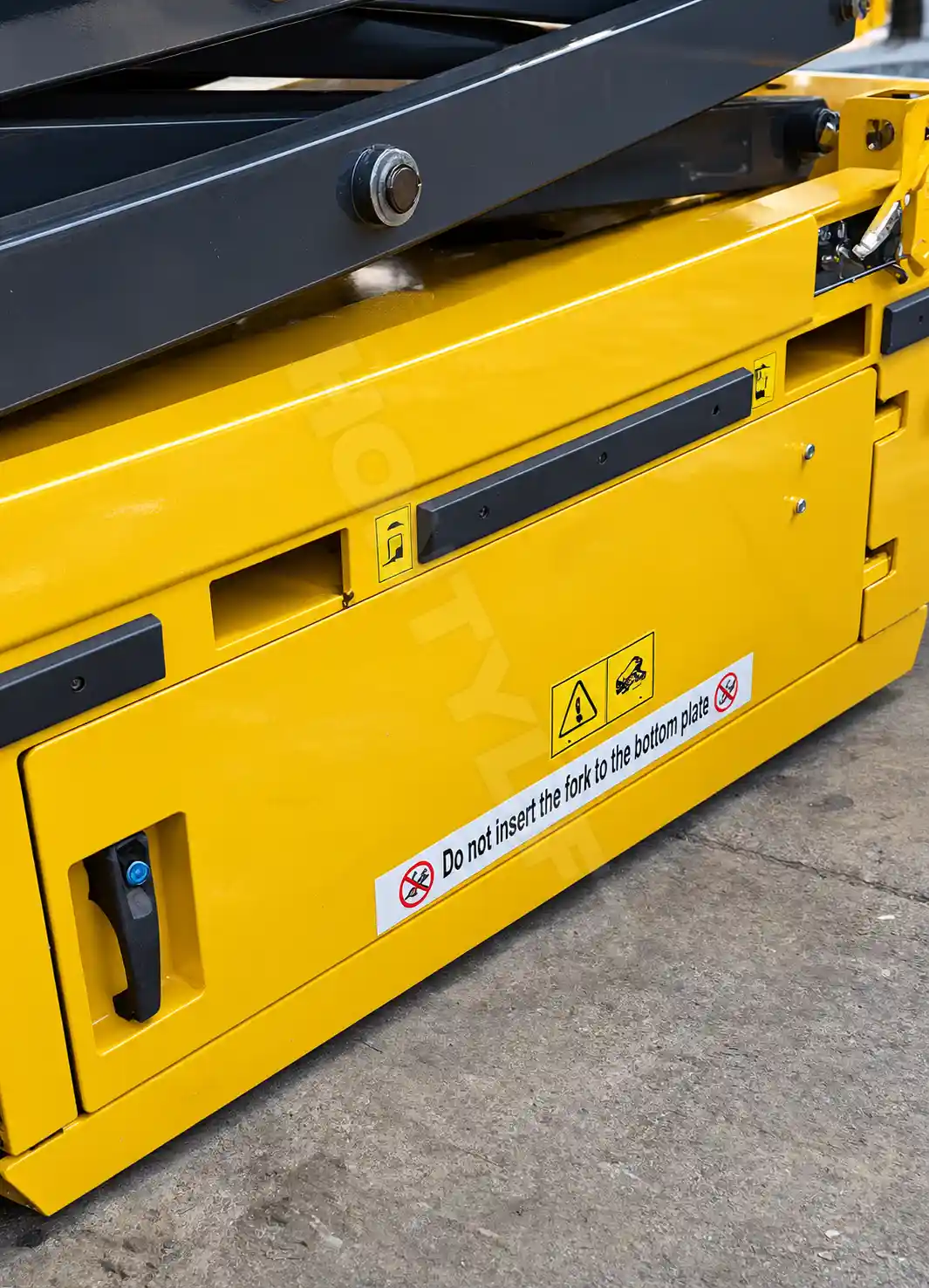
The pothole protection bar and its limit switch seen from below.
Platform gate. On every scissor lift we build, the gate has an interlock that inhibits lift and drive when it is not fully closed. The check has to be done with the platform off the ground, because a gate that is wired correctly but adjusted loosely can read closed at the bottom and open at height. If the machine lifts but will not drive, start here.
Pothole protection. The bars or pads under the chassis deploy as the platform rises and must reach their limit switches before the machine is allowed to drive at height. This is the interlock that surprises people, because it engages on ground that looks flat. A 40 mm recess at a loading dock, a drain grate, a trench cover, an expansion joint with a missing filler: all of them are potholes as far as the machine is concerned.
Tilt. The scissor lift has two angle limits, not one. On our standard models the allowance is 1.5 degrees for lifting and 3 degrees for driving, and the higher models are set slightly differently. Exceed the lift limit and the platform stops where it is. Exceed the drive limit and the drive stops. Both are recoverable: lower the platform, move to level ground, and the machine resets.
| Symptom | Most likely cause | Where to look first |
|---|---|---|
| Lifts, will not drive | Gate interlock, or a pothole bar that has not reached its switch | Gate striker plate; both bars underneath |
| Drives, will not lift | Tilt limit exceeded, or overload | Level ground, then the load on the platform |
| Stops mid-lift with an alarm | Overload or tilt, in that order | What went onto the platform in the last minute |
| Nothing works, no display | Emergency stop, isolator, or a flat pack | The red button on both stations |
The bar hangs under the chassis on a linkage and drops as the platform rises. A limit switch confirms that it has dropped. If the bar meets an obstruction on the way down, or the switch does not close, the controller inhibits drive. That is the design intent, and it is the reason a machine parked over a drain will refuse to move even though it drove onto the drain ten seconds earlier.
Four failures account for nearly all the real faults we see:
Do this before calling anyone, and write down what happens:
If all four behave, the electric scissor lift is fine and the site is not. If any of them does not, you have narrowed it to one interlock before the technician arrives, which is usually the difference between one visit and three.
Do not bypass a pothole switch to get the machine moving. It is the most common contributing factor in scissor lift tip-overs, because the protection exists for the one moment when a wheel drops into something the operator did not see. A machine with a bridged switch will drive happily until the day it does not, and the failure is not gradual.
We have seen it done with a cable tie holding the lever up, which is at least honest, and with the switch removed and the plug shorted, which is not. Both void the warranty, and both would fail the first inspection under any regime.
If all three interlocks test clean and the machine still refuses to drive, the fault is in the controller or its inputs, and that is a diagnostic-code job rather than a roadside one. On our machines the controller logs the last inhibit, which is why the first question our service desk asks is whether the display showed a code rather than what the operator was doing at the time.
Errors get resolved faster when the machine is described by what it refuses to do rather than by what it stopped doing. "Lifts, will not drive, bars deploy" reaches a diagnosis in one exchange. "It broke" takes a week. Our service desk takes both, but prefers the first. The wiring is the same across the self-propelled scissor lift range, so the test above works on a 6 m machine and a 16 m machine alike.
Send the working height, the load and the site constraint. An engineer replies with a model recommendation and a written quotation within one business day — or tells you it cannot be done.
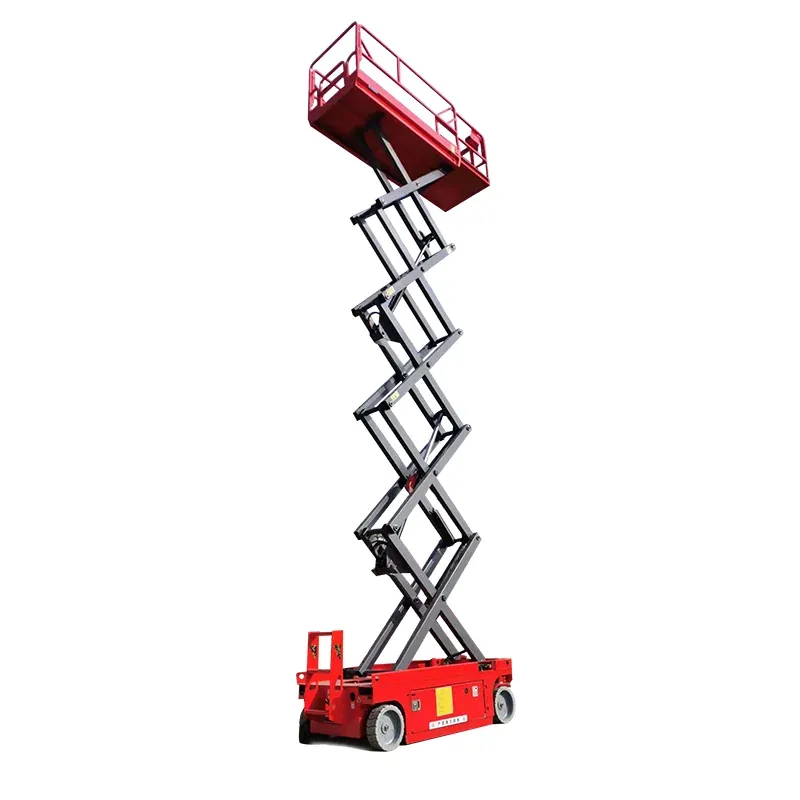 GTJZ-1416 45ft (13.8 m) Scissor Lift, No Outriggers — 230 kg