
en

Replacing the battery pack is the most expensive way to fix a charger, and it is what happens when the diagnosis starts at the wrong end. We see it several times a month on scissor lifts: a new pack fitted, the same symptom within a fortnight, and the actual fault still sitting in the charging circuit.
This is the order we use on the bench for a 24 V electric scissor lift, and it takes about forty minutes. Every step has a number attached, so the decision at each point is a comparison rather than an opinion.
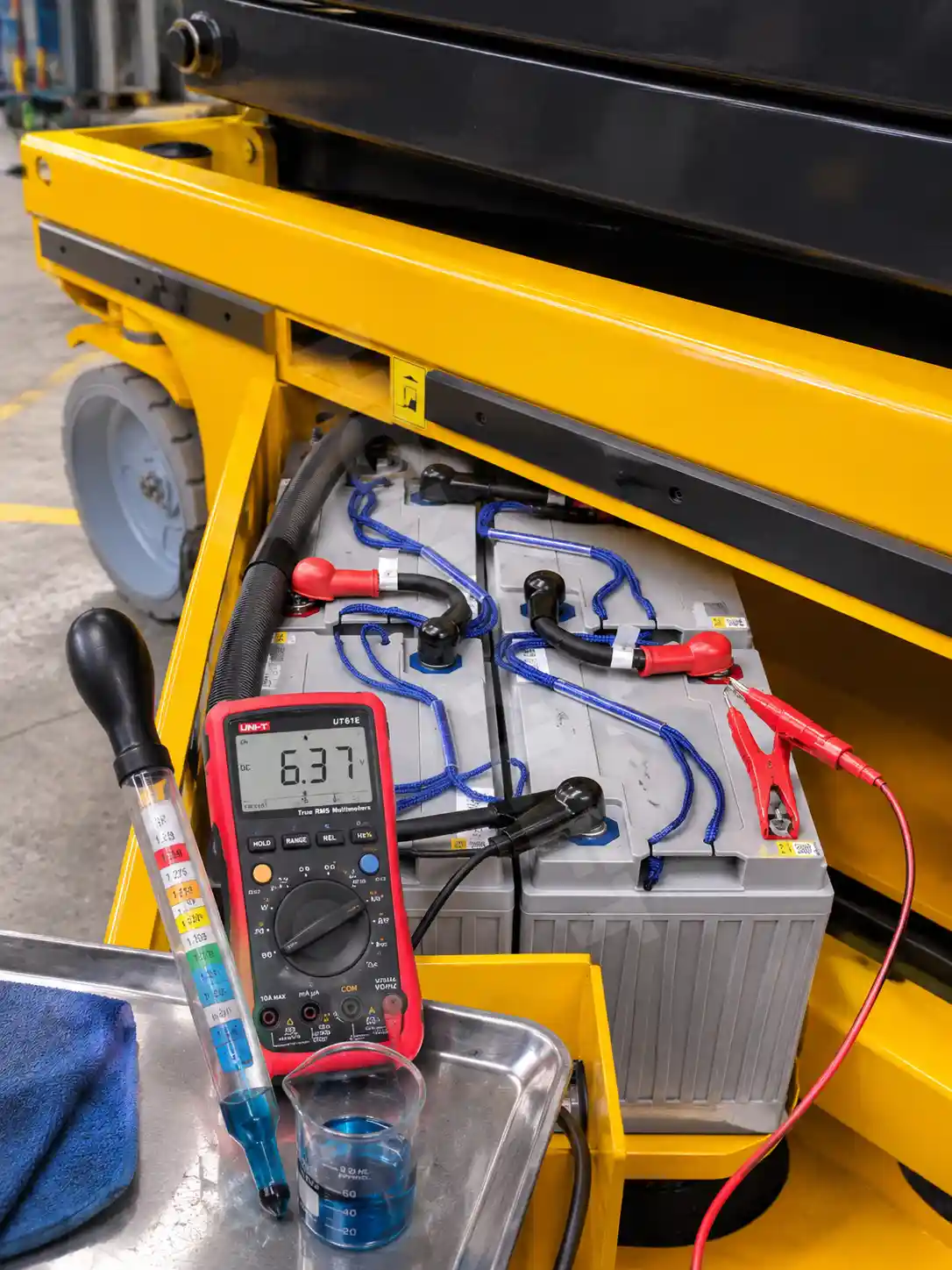
A multimeter connected to the battery terminals during a diagnostic check.
Switch everything off, leave the pack to settle for two hours, and measure across the pack terminals. A 24 V lead-acid pack is twelve cells, so the useful figures are per cell multiplied by twelve:
| State of charge | Volts per cell | Pack voltage | Specific gravity |
|---|---|---|---|
| 100% | 2.12 | 25.4 | 1.265 |
| 75% | 2.07 | 24.8 | 1.225 |
| 50% | 2.03 | 24.4 | 1.190 |
| 25% | 1.98 | 23.8 | 1.155 |
| Discharged | 1.93 | 23.2 | 1.120 |
A pack that reads 25.4 V after a rest and still will not last a shift has a capacity problem rather than a charge problem, and you can skip to step 3. A pack that reads 24.0 V after a full charge cycle has a charging problem, and step 4 is where you should be.
Static voltage tells you the state of charge. Loaded voltage tells you whether the pack can deliver current. Lift the platform with a rated load and watch the display or a meter across the pack while the pump is running.
A healthy electric scissor lift battery holds above 22 V under that load. A pack that drops below 21 V while lifting, and recovers to 24 V the moment the pump stops, has high internal resistance. That is the classic signature of a sulphated or aged pack, and it explains the symptom the operator actually reports: the electric scissor lift works fine for ten minutes and then goes slow.
Twelve readings, written down. This is the only test that finds a single bad cell, and a single bad cell is the most common reason a four-block pack fails early. One cell reading 1.150 while the other eleven read 1.250 is a dead cell, and the pack is finished regardless of what the total voltage says.
Two rules on the hydrometer. Take the reading after a full charge and a rest, not after topping up with water, because the water has not mixed yet. And if a cell reads low, charge and re-test before condemning it: a stratified electrolyte gives a false low reading on the cell nearest the filler.
This is the step that gets skipped, and it is where half the real faults live. Connect a meter across the pack with the charger running and watch the voltage climb.
A 24 V charger in good order reaches about 28.8 V at the end of the absorption phase, then drops to a float of around 27.0 V. If the voltage stops at 26.5 V, the charger is undercharging and the pack will never reach full capacity. If it climbs past 29.5 V, it is cooking the electrolyte, and you will find the water level low on every check.
Then check the current. Our standard charger is 24 V / 30 A, and a 200 Ah pack from empty needs a little over six and a half hours at full output plus the taper, so seven to eight hours in practice. The compact models use a 24 V / 25 A charger, which is eight to nine hours on the same pack. A customer who reports "it used to charge overnight and now it does not" is often reporting a charger that has lost output, not a pack that has lost capacity.
Measure the voltage at the charger output and again at the pack terminals while charging. More than 0.5 V difference means resistance in the path, and the usual suspects are the connector pins, the terminal lugs and the chassis earth. A corroded lug costs a few dollars and produces exactly the symptoms of a failing pack, because the pack never sees the full charge voltage.
A rental customer replaced a pack, then replaced it again six weeks later, then called us. The pack was fine both times. The charger had been set to the wrong profile during a repair and was floating at 26.4 V, which is enough to run the machine for a week and not enough to bring a 200 Ah pack back to full. The cells had sulphated in service, which is why the second pack died faster than the first.
The whole diagnosis took twenty minutes once someone measured the charger. Two packs and two months of downtime had gone into avoiding that measurement.
Rest voltage, loaded voltage, twelve gravity readings, charger voltage at absorption, charger current, and the voltage difference between charger and pack. Six lines. Send them to us and we can tell you which of the three components is at fault before anyone travels.
And if the answer is a pack, replace it with the same capacity and the same physical size. Fitting a larger pack to a scissor lift with a 30 A charger only lengthens the charge time, and it moves the weight, which the machine was not designed for. Send us the six readings and the model, and we will tell you what we would fit. The pack is the same 24 V / 200 Ah unit across most of the self-propelled scissor lift range, which is why one diagnostic order covers the fleet.
Send the working height, the load and the site constraint. An engineer replies with a model recommendation and a written quotation within one business day — or tells you it cannot be done.
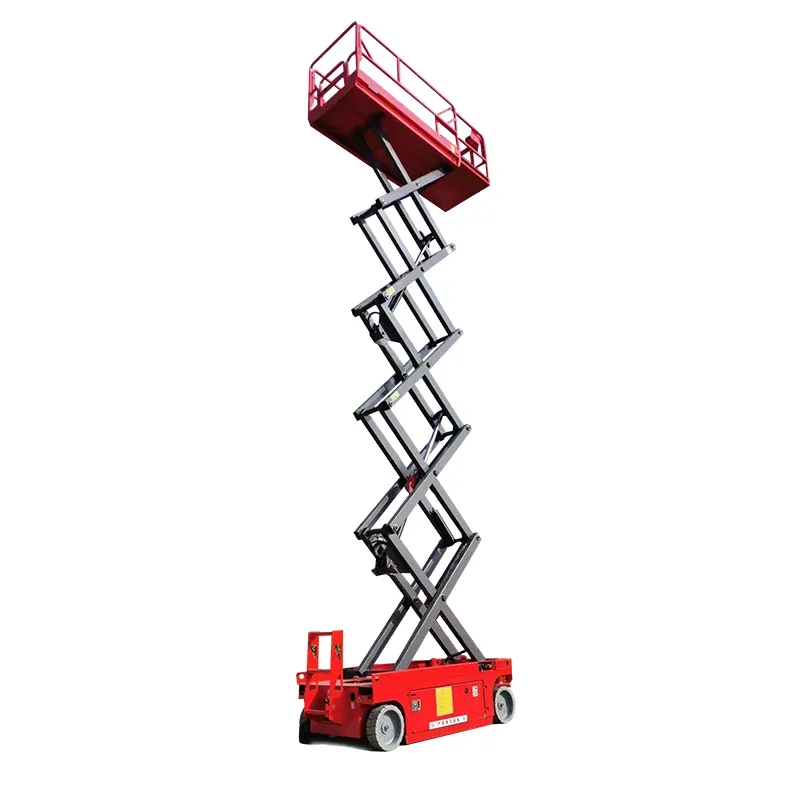 GTJZ-1012 32ft (9.8 m) Self-Propelled Scissor Lift — 320 kg